Choosing well · EDITORIAL GUIDE
Pencil History Explained: From Borrowdale Graphite to Conté's Clay Lead and Japan's First Pencil Factory
The wood-cased pencil took shape in stages. High-quality graphite was found at England's Borrowdale mine in the 1560s, and the first pencils were pieces of it set into wood. In 1795 the Frenchman Nicolas-Jacques Conté fired graphite mixed with clay, and the Japanese maker Mitsubishi Pencil says cores are still basically made his way. Japan began using pencils in earnest after the Meiji Restoration of 1868 and started industrial production in 1887. This guide is based on three official Japanese-language pages from Mitsubishi Pencil (checked October 22, 2026).
Is there lead in a pencil?
Mitsubishi Pencil's FAQ says a black pencil core is made of graphite and clay. Colored pencil cores contain no clay; they use pigment, talc and wax for smoothness, and glue to bind them. The sources list no metallic lead. The Japanese word for pencil, enpitsu, also contains the character for lead.
Who made the first pencils?
According to Mitsubishi Pencil's history page, people first wrote with small pieces of Borrowdale graphite or wrapped string around the grip. The first pencils were graphite shaved into a slab or stick and fitted into wood; some were just graphite wound with thread. Because the core was raw mined graphite, quality likely depended on the ore. That is our inference, not the source's.
How pencil lead changed: from sulfur to Conté's clay method
When Borrowdale's graphite ran out, makers melted graphite powder with sulfur and kneaded it into rods. In 1760 the German Kaspar Faber made cores of graphite powder bound with sulfur and other materials. In 1795 Conté replaced the sulfur with clay, fired the mix, and found that changing the ratio changed the hardness. We think this ability to make cores to a target hardness helped pencils spread, but the source does not say so.
How are pencils made today?
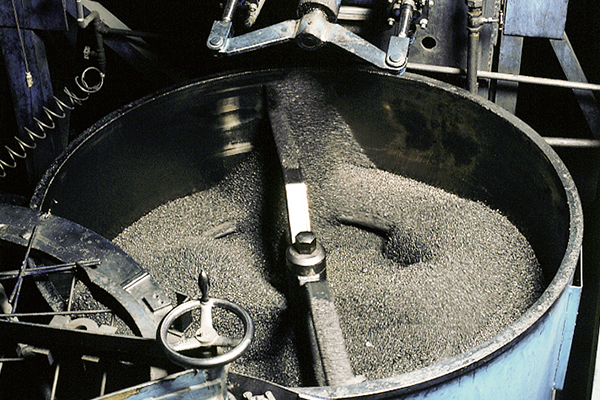
Mitsubishi Pencil's factory-process page describes the steps. Graphite, clay and water are mixed and formed into a cylinder about 10.5 cm across and 35 cm long. Leads are cut to about 20 cm, fired, soaked in hot oil and cooled. The wood is mainly incense cedar, a type of cypress from California's Sierra Nevada; the FAQ adds that the tree reaches 30 m tall and 1 m across. It arrives in Japan as thin boards called slats. Leads are glued into grooves between two slats; the sandwich is split into pencils, painted, trimmed and boxed by the dozen.
Lead firing temperature: 1,000 to 1,200°C
Slat size: 185 mm long, 70 mm wide, 5 mm thick
Grooves per slat: 9
When did pencils come to Japan?
The oldest pencil surviving in Japan is said to be one of about 6 cm, shown at the Kunozan Toshogu Museum in Shizuoka Prefecture among the belongings of Tokugawa Ieyasu, the first Tokugawa shogun. Its lead is Mexican and its holder is akagashi, a Japanese evergreen oak. It is said to have been a gift from Spain or its territories of the time, Mexico or the Philippines. The feudal lord Date Masamune is thought to have used one: a pencil of about 7 cm was found when his mausoleum, Zuihoden, was excavated in 1974.
Pencils came into real use only after the Meiji Restoration. As German imports, they reached few people; most wrote with brushes, slate pencils or handmade quill pens. In 1887 (Meiji 20, the 20th year of the Meiji era), Niroku Masaki built the water-wheel-powered Masaki Pencil Manufacturing Works at 1 Naito-Shinjuku, Yotsuya Ward, Tokyo City, now 1 Naitomachi, Shinjuku. It was the beginning of today's Mitsubishi Pencil Co., Ltd.
Pencil history timeline: before and after Conté
1560s onward: shaved graphite set into wood
1760: graphite powder bound with sulfur and other materials
1795 onward: graphite and clay fired together, ratio sets hardness
Today's black core: graphite and clay, fired at 1,000 to 1,200°C, soaked in oil
Today's colored core: pigment, talc, wax and glue, no clay
The wooden casing existed from the start; what changed was the core.
What to check when choosing a pencil
First, black or colored: their cores differ at the root, so do not judge them by the same standard. Second, hardness: since it is set by the graphite-to-clay ratio, check that the maker offers the hardness you need. Third, wood: Mitsubishi Pencil mainly uses incense cedar; for other brands, check each maker's information.
Buying Japanese pencils from outside Japan
The pages used here are written for Japan, and the products they describe are made for the Japanese domestic market. We did not confirm which models are officially sold abroad. The usual routes are Japanese retailers that ship internationally or proxy-buying services that purchase in Japan and forward to you. Product details may be in Japanese only, so confirm the hardness before ordering. New and limited releases often sell out soon after launch.
Editors' take
Overseas readers curious about how pencils are made should read Mitsubishi Pencil's history and manufacturing pages together, with browser translation if needed: one traces the core to Conté's still-used method, the other shows today's process. Before importing, decide between black and colored pencils, and read hardness labels knowing they reflect the graphite-to-clay ratio. Importing is worth it only when the model and hardness you want are unavailable locally. Teachers can add Japan's chapter to a pencil-history lesson: Ieyasu's 6 cm pencil and Masaki's 1887 water-wheel factory.
Sources and references
https://www.mpuni.co.jp/special/qa/history.html